
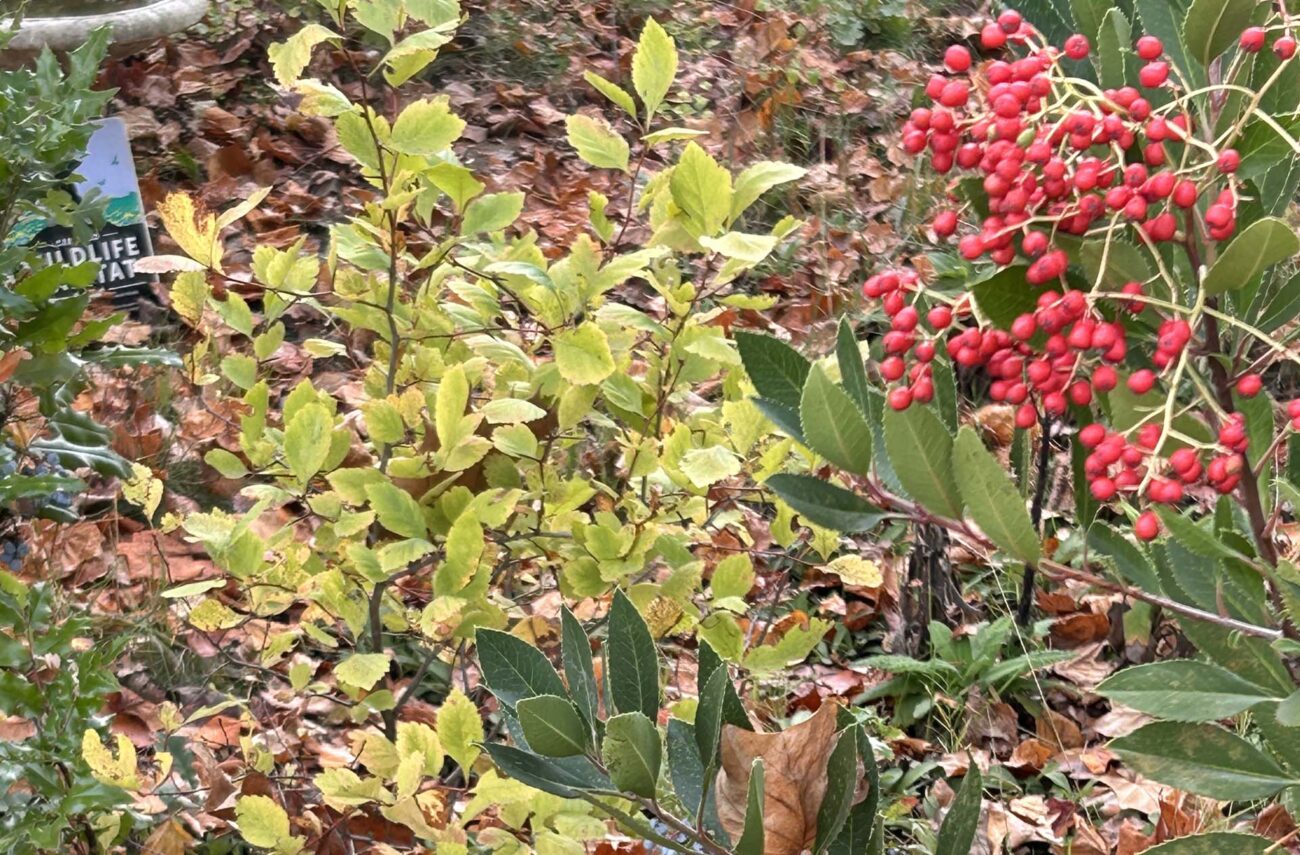
Photo taken October 30, 2025, by MaryAnn McCrary.
The chill and dark of December bring a natural time to draw inward, go “dormant” like many plants . . . rest . . . all, of course, preparing the way for a burst of growth in the spring. And spring does begin early in California! In late January, on a sunny afternoon, it is not unheard of to find annuals in bloom on thin-soil volcanic mudflow lands, for example, at the Bend unit of the BLM land northeast of Red Bluff, and on Millville Plains east of Redding. When do these early bloomers get their start? Typically, in December.
These apparently “dormant” reflective December days are some of the most valuable and essential for the nursery as well. The Shasta Chapter nursery has always been an effort shared among volunteers, with one or two volunteers heading it up. The lead volunteer(s) then necessarily wear many hats: in addition to the hands-on management of the nursery, there is planning for what to include in the inventory, building a band of active volunteers and coordinating with them, advertising for spring and fall sales, and preparing the nursery stock for sales with labels and helpful information for each species. These are predictable, expected aspects of running a nursery, but how they are done changes and must change as circumstances have changed for CNPS members and everyone else.
What I’m getting at is that we’re in a transition from pre- to post-fire landscaping; from pre- to post-social media levels of volunteerism and in-person socializing; and from pre- to post-baby boomers aging into armchair activism and many redefined priorities.
Of course, CNPS is not just for one generation and never has been. CNPS was founded in 1965 after a group of citizens worked together to save a native plant garden in Berkeley’s Tilden Park. The initial members would have been the age of the parents and grandparents of the post WW2 baby boom.
What is True North for the California Native Plant Society? Here’s the opening statement in Wikipedia for CNPS:
The California Native Plant Society (CNPS) is a California environmental non-profit organization (501(c) (3)) that seeks to increase understanding of California’s native flora and to preserve it for future generations. The mission of CNPS is to conserve California native plants and their natural habitats, and increase understanding, appreciation, and horticultural use of native plants throughout the entire state and the California Floristic Province.
According to this mission statement, the Shasta Chapter nursery, the sales, and activities that make it all happen are a central—although certainly not the only—important aspect of what we do together as a volunteer organization. The nursery never was and never could be held together entirely by one or even two obsessed volunteers.
There is an ironic thing going on these days with so many diverse ways to let our opinions be known via social media, Zoom meetings, and email. Even with so many communication options, the Shasta Chapter CNPS Board of Directors and the volunteer Nursery Manager (we’re all volunteers on this bus) feel completely in the dark concerning what most Chapter members want to see in our nursery, from our nursery, and whether and how you would like to participate. We would like very much to hear from you. You can always send a message to shastacnps@gmail.com. That is the “suggestion box” for the Shasta Chapter.
Free-form opinions and suggestions are welcome. For anyone who might appreciate questions from recent nursery experience for starters, here are a few I’ve been wondering about.
- Our nursery is not the only source of native plants in the Redding area. But we are the only nursery that is funding scholarships for students headed to 4-year colleges. Our inventory has some unique species, and we also try to provide the most popular native plants for home gardeners. Consequently, we can’t help but directly compete for sales with the other three sources of native plants in Redding.
- Does the fact that our proceeds go toward botanical and biological education for young people influence where you buy native plants?
- Does CNPS’ decades long activism for protecting natural areas and plants influence where you buy native plants?
- If none of the preceding, what does influence you to buy a species from us that is also available from another source in Redding?
- For a couple years, all the nurseries have had their fall sales at the same time or very close to the same time.
- Is this a plus for customers?
- Is it a Native Plant Fest, or just an overwhelming situation with too little time to shop?
- As it is, the online store is an option for a limited time after the in-person sales and sometimes also in early spring.
- Would you order from us if we had the online store operating more continuously?
- Would you like to see us offer more species as seeds?
The Shasta Chapter CNPS nursery is running on a blend of botanical and horticultural know-how mixed with a fair amount of beginner’s luck and study in “You Tube University.” I conveniently consider this to be a positive rather than a negative. The fact that “You Tube University” exists and one can learn a lot about propagation there will be very convenient when we come to the point where Legacy Planning, or the lack thereof, forces the “volunteer nursery manager hat” to move on. I am not jealously guarding that hat; I would absolutely love to find someone younger than 70 to share in the many enriching experiences of growing native plants.
To whoever you are out there in younger generation land: if you don’t want to work with a Boomer, I get it. In that case, you can have the whole enchilada. It’s here, just waiting for someone or a committee or small club of friends to take it on. Preferably the collective approach will happen. This “job” is not a single job, it is a collection of jobs that use diverse abilities and lots of time when totaled up. But, divided among a team that works well together, it would seem relatively easy and even joyful. Growing plants comes highly recommended for maintaining a happy outlook, because it works . . . it really does. ~Nursery Manager, MaryAnn McCrary